

In today’s fast-paced digital economy, customer service is no longer just a “support” function—it is a critical driver of brand loyalty and revenue. However, for many growing businesses, the cost and logistical complexity of maintaining a 24/7 in-house team are prohibitive.
A virtual assistant for customer service acts as a bridge, offering the professional reliability of a dedicated employee with the flexibility of a remote model. This guide explores how these specialists can transform your support operations, allowing you to reinvest the savings into high-impact areas.
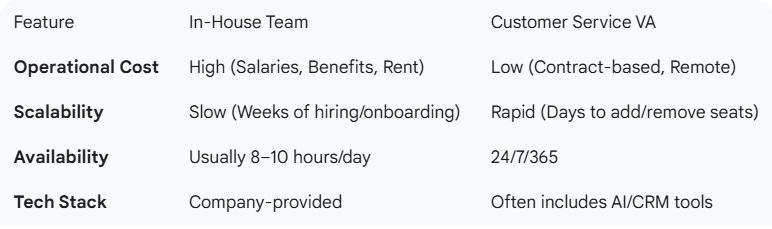
Modern customers expect answers in real-time, regardless of time zones. While an in-house team might operate on a standard 9-to-5 schedule, a virtual assistant (VA) can provide coverage during nights, weekends, and holidays.
By partnering with a global BPO (Business Process Outsourcing) provider like MBM Solutions Inc., you gain access to high-performing remote teams in the Philippines. This allows your business to:
The best virtual assistants don’t just work harder; they work smarter. Today’s top-tier VAs use AI-enhanced tools to automate repetitive tasks—such as ticket tagging, basic FAQ responses, and data entry.
This human-AI collaboration ensures:
Outsourcing customer support is one of the fastest ways to lower operational costs. The savings realized from hiring a virtual assistant for customer service can be redirected toward the structural “backbone” of your company.
For instance, instead of spending your entire budget on customer service salaries, you can allocate funds to:
Unlike generic chatbots, specialized VAs bring expertise in specific sectors. Whether you are in healthcare (requiring HIPAA compliance), fintech (requiring fraud awareness), or e-commerce (requiring logistics tracking), a dedicated VA “pod” can be trained to integrate seamlessly with your unique business processes.
1. Can a virtual assistant for customer service handle technical support?
Yes. Many VAs are highly skilled in technical troubleshooting and can be trained to use specific software or hardware. They often act as Level 1 support, escalating only the most complex bugs to your internal engineering team.
2. Is it safe to give a virtual assistant access to my customer data?
Security is a top priority for professional BPO partners. Firms like MBM Solutions use secure, compliant workflows and encrypted tools to ensure that customer data is handled with the same level of integrity as if it were handled by an in-house employee.
3. How does hiring a VA help with my business accounting?
While a customer service VA handles the “front end,” the cost savings they provide allow you to invest in professional business accounting and bookkeeping services. Furthermore, some VAs are cross-trained to help with basic invoicing and expense tracking, supporting your overall financial health.
4. What are the best payroll services for small businesses to use with remote teams?
When working with global VAs, look for payroll services that handle international compliance, such as Deel, Rippling, or Papaya Global. These platforms ensure your remote assistants are paid accurately and in accordance with local labor laws.
5. Will my customers know they are talking to a virtual assistant?
If the VA is well-integrated and trained in your brand voice, the experience should be seamless. Most customers care more about the speed and quality of the solution than the physical location of the person helping them.